Digital Marketing Agency will help you to test your brand digital performance
(For Free, In 60 Seconds)

Home » AEO( Answer Engine Optimization )
AEO( Answer Engine Optimization )
Get In Touch
What is AEO(Answer Engine Optimization?
The Key Aspects of AEO:
- Concise and Direct Answers: Providing clear and concise responses to user queries.
- Natural Language: Using conversational tone and language to match user queries.
- Structured Data Markup: Adding schema markup to help search engines understand content context.
- User Intent: Understanding and catering to user intent behind queries.
- Voice Search Optimization: Optimizing content for voice search queries.
Examples of answer engines:
– Google Knowledge Graph : Gives quick facts and answers at the top of search results.
– Featured Snippets : Short answer boxes that directly answer your question.
– Voice Assistants : Like Siri, Alexa, and Google Assistant, which provide quick answers to voice queries.
Why is AEO Rising?
AEO (Answer Engine Optimization) is rising due to several factors:
- Increased use of voice search: More people are using voice assistants like Siri, Alexa, and Google Assistant to ask questions.
- AI-powered search results: Search engines are incorporating AI to provide direct answers to user queries.
- Changing user behavior: Users expect quick and accurate answers to their questions.
- Growing importance of featured snippets: Featured snippets are becoming a key way for content to appear in search results.
- Shift to conversational search: Users are using more natural language when searching, making AEO crucial for providing relevant answers.
These factors are driving the need for AEO strategies to optimize content for answer engines and provide users with direct, accurate answers.

Why is AEO Important for Content Marketers and Businesses?
In today’s digital landscape, Answer Engine Optimization (AEO) has become crucial for content marketers and businesses looking to stay ahead of the competition. As users increasingly rely on voice search and smart assistants like Google Assistant, Siri, and Alexa, traditional SEO is no longer enough. Here’s why AEO matters:

1. Visibility in Voice Search and Smart Assistants
AEO focuses on optimizing content to be directly pulled as answers by search engines and voice assistants. This means your content can be featured in position zero or the featured snippet, significantly increasing visibility and clicks.
2. Captures the "Zero-Click" Audience
A growing number of searches now end without a click, especially when the answer is shown directly on the results page. AEO helps your content appear in this crucial space, ensuring your brand is seen even if users don’t visit your site.
3. Boosts Authority and Trust
When your content is selected as the best answer, it builds credibility and trust. Search engines favor accurate, concise, and authoritative content—hallmarks of strong AEO strategy.
4. Improves User Experience
AEO encourages content creators to structure information clearly and logically. This not only helps search engines understand your content better but also enhances the user experience by providing quick, relevant answers.
5. Competitive Advantage
Many businesses are still catching up with AEO. By adopting it early, your brand can outperform competitors, especially in niche or long-tail keyword queries.
Why Choose DigitalZap for AEO?
DigitalZap is a leader in providing best-in-class AEO services. With a proven track record in content optimization, voice search readiness, and technical SEO, DigitalZap ensures your business content is not just searchable—but answerable.
Whether you’re aiming to dominate voice search, improve your Google snippets, or build a more responsive content strategy, DigitalZap has the expertise to get you there.


What is AEO Vs SEO?
In the world of digital marketing, two important terms are gaining attention: SEO (Search Engine Optimization) and AEO (Answer Engine Optimization). While they sound similar, they serve different purposes and are both essential for online success.
Let’s break them down:
What is SEO (Search Engine Optimization)?
SEO is the practice of optimizing your website and content so that it ranks higher on search engine results pages (SERPs) like Google, Bing, or Yahoo.
Goal: To drive organic (unpaid) traffic by improving visibility for specific keywords.
Example of SEO:
Let’s say you run a bakery in New York and want people to find your website when they search for:
“best cupcakes in New York”
If your site appears on page 1 of Google for that search term, your SEO is working. You probably used keywords, optimized your images, had fast load times, and built backlinks.
What is AEO (Answer Engine Optimization)?
AEO is about optimizing your content so that it can be directly used by answer engines—like Google’s featured snippets, voice assistants (Siri, Alexa), and AI-based tools (like ChatGPT or Google SGE)—to answer user questions.
Goal: To be selected as the best and most direct answer to a user’s query, even without them clicking through to your website.
Example of AEO:
Someone asks their phone:
“How many calories are in a chocolate cupcake?”
If your website is structured well and provides a clear, concise answer, Google may feature your answer in the snippet or read it aloud via voice assistant.
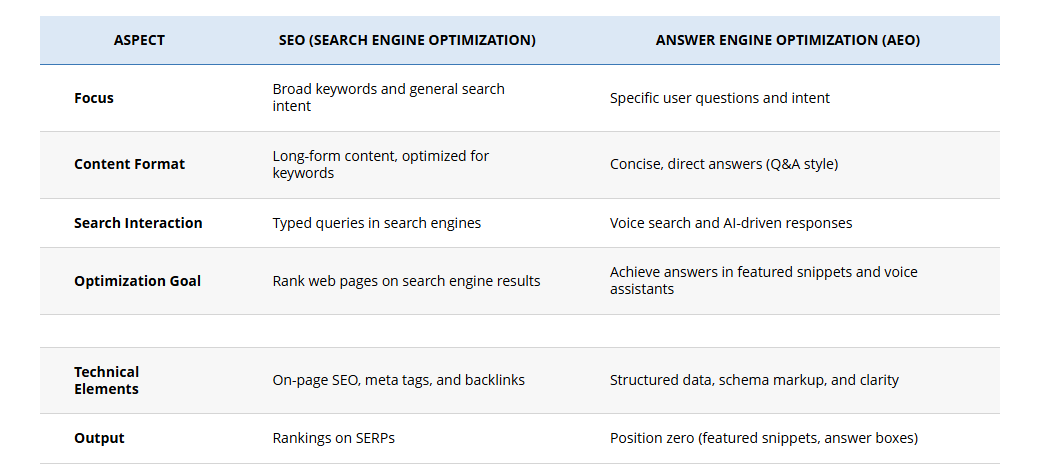
Key Differences: AEO vs SEO
Feature | SEO | AEO |
Focus | Ranking on search result pages | Being featured as the best answer |
User Intent | Keyword-based searches | Question-based, conversational queries |
Output | Website link appears on SERP | Direct answer shown or spoken |
Example | “Cupcake recipes near me” | “How do I make cupcakes from scratch?” |
Tools Optimized For | Google, Bing, Yahoo | Google Snippets, Siri, Alexa, ChatGPT |
Why Both Matter:
- SEO brings in traffic by ranking your site.
- AEO increases your visibility without needing a click by positioning your brand as the expert answer.
- Combining both can supercharge your digital strategy—you get traffic and top-of-mind awareness.
AEO is not a replacement for SEO—it’s the next step in digital optimization. As search behavior evolves with voice search and AI tools, businesses that invest in both SEO and AEO will stay ahead of the curve.
AEO vs. SEO: Which is Better?
AEO (Answer Engine Optimization) and SEO (Search Engine Optimization) are both important for online visibility. Here’s a simple comparison:
SEO:
– Focuses on ranking websites in search results
– Uses keywords, backlinks, and content optimization
– Drives traffic to websites
AEO:
– Focuses on providing direct answers to user questions
– Uses natural language and concise responses
– Often appears in featured snippets, voice search, and knowledge panels
Which is better?
It’s not necessarily a question of which one is better. AEO and SEO can work together to:
– Increase online visibility
– Drive more traffic to websites
– Provide users with relevant and accurate answers
The key is to understand your goals and audience. If you want to drive traffic to your website, SEO might be more important. If you want to provide quick answers and establish your brand as an authority, AEO could be the way to go.
Ultimately, a combination of both AEO and SEO can be the most effective approach.
Why AEO is the Next Step in Search Optimization?
AEO is the next step because it helps businesses stay ahead in the changing search landscape. Here’s why:
– SEO still matters: It’s still important for driving organic traffic to your website.
– AEO takes it further: By optimizing for direct answers, you can meet the growing demand for quick and accurate information.
– Modern users expect more: They want fast, relevant, and precise answers, and AEO helps you deliver that.
By embracing AEO, you can:
– Stay competitive in the evolving search landscape
– Increase your online visibility
– Provide users with the information they need, quickly and accurately
AEO is not replacing SEO, but rather building on it. By combining both strategies, you can maximize your online presence and reach your target audience more effectively.
How AEO Works: Simple Guide
AEO (Answer Engine Optimization) helps your content appear in search results that give direct answers. Here are the key strategies:
- Understand User Intent: Create content that answers specific questions people are asking.
- Use Structured Data: Organize your content so search engines can easily understand and display it.
- Optimize for Featured Snippets: Use clear headings, short paragraphs, and lists to make your content easy to read and extract.
- Create Q&A Content: Use FAQ-style sections to answer common questions in your niche.
- Make Content Clear: Use simple language, short sentences, and organized formatting.
- Build Authority: Cite credible sources, include expert input, and link to other relevant content.
- Analyze Competitors: Study competitors who are ranking well and create better content.
By following these strategies, you can increase your chances of appearing in direct answer formats and reach your target audience more effectively.
Implementing AEO in Your Content Strategy
To get started with AEO, follow these steps:
Step 1 : Question-Based Keyword Research
– Identify common questions your target audience is asking using tools like Ahrefs or SEMrush.
– Focus on long-tail, conversational keywords that match user intent.
Step 2 : Competitor Research
– Analyze competitors’ ranking for featured snippets or voice search results.
– Look at their content structure, schema markup, language, and tone to identify gaps and opportunities.
Step 3 : Schema Markup
– Use Google’s FAQ structured data guidelines and (link unavailable) to help search engines feature your content.
– Focus on relevant markup types like FAQPage, Q&A, and HowTo schemas.
Step 4 : Content Optimized for Featured Snippets
– Use short, clear paragraphs to answer questions.
– Include bullet points, numbered lists, and tables.
– Add FAQ sections that address multiple related questions.
Step 5 : Optimize for Voice Search
– Use natural, question-based language.
– Answer queries within 30-40 words.
– Ensure content readability and clarity.
Step 6 : Build Topical Authority
– Create content clusters around key topics.
– Answer multiple related questions comprehensively and link between relevant pages.